
An Experiment with AI Book Translation: “The Mistakes That Make Us” in 31 Languages
I've used the LeanPub.com publishing platform for a long time. I initially published Practicing Lean and Measures of Success as iterative “in progress” books that people could buy while I was still adding chapters and making revisions. Those books are still available there today.
This post covers my early experiment with translating an AI book using LeanPub's new TranslateAI feature.
I used LeanPub differently with my most recent book, The Mistakes That Make Us: Cultivating a Culture of Learning and Innovation, as I made it available there only after the book was fully ready to publish. It's one of the e-bookstore alternatives for those who don't want to use Amazon.
Update: The book is now a Shingo Publication Award Recipient!
I didn't have a good reason not to publish that one using the LeanPub “publish early and often to get feedback” model.
An Early Experiment with AI Book Translation
I've used LeanPub to run experiments:
- Early experiments in eBook publishing (“Best of Lean Blog” collections)
- An experiment with a collaborative book (Practicing Lean)
- An experiment with Measures of Success to see if I should make an investment in getting a nice print book done
In the past few months, LeanPub offered an opportunity to be an early adopter in a new experiment: automated book translations using ChatGPT.
They call this “TranslateAI.”
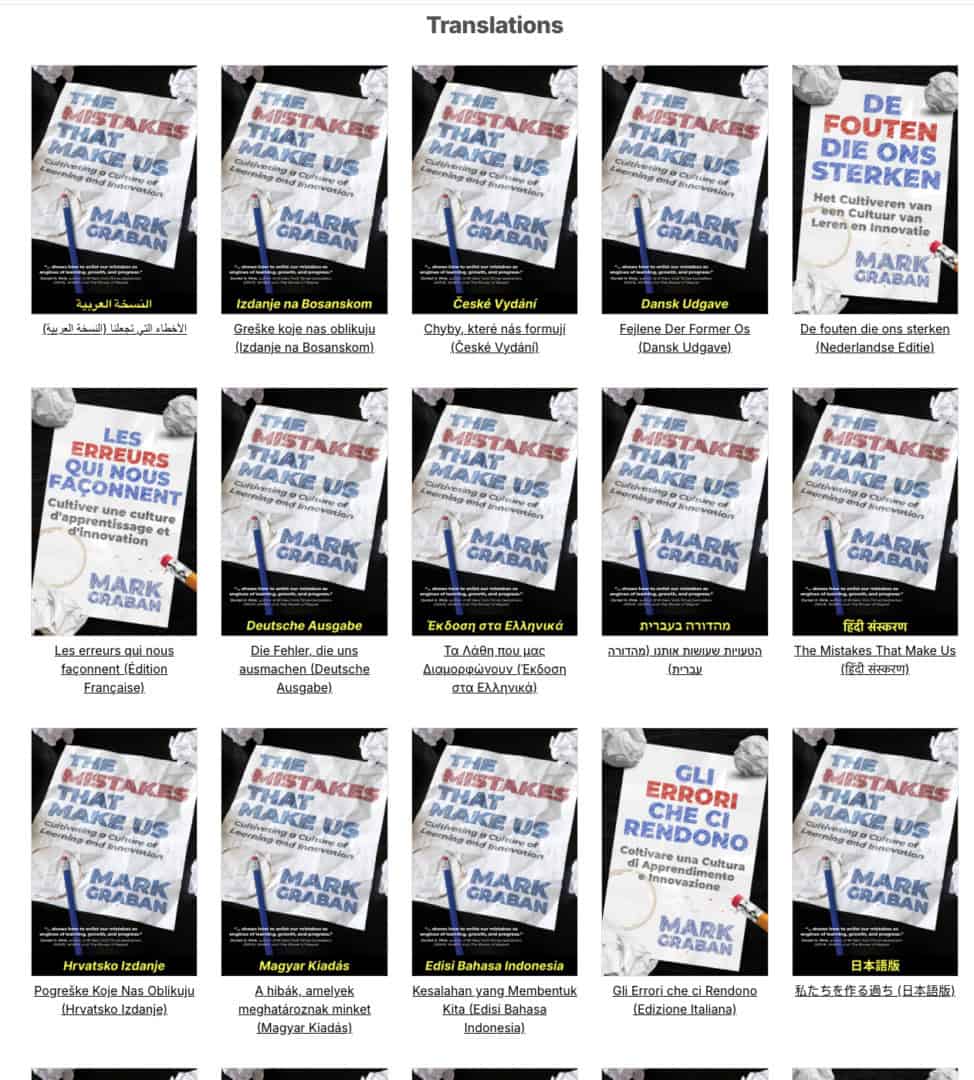
My book is now available in 31 languages. You can see some of them in the image below. LeanPub automation creates covers for the translations that use the original cover with text added at the bottom (to signify the language, in yellow).
In a few cases, I've experimented with creating covers that are similar to the English edition, but using that language (such as Dutch and French, as seen below).
The 31 languages are:
- Arabic
- Bosnian
- Chinese (Simplified)
- Chinese (Traditional)
- Croatian
- Czech
- Danish
- Dutch
- English
- French
- German
- Greek
- Hebrew
- Hindi
- Indonesian
- Italian
- Japanese
- Korean
- Norwegian (Bokmål)
- Polish
- Portuguese (Brazilian) – Also available via Amazon as a paperback or Kindle
- Portuguese (European)
- Punjabi
- Romanian
- Serbian (Latin)
- Spanish
- Swedish
- Thai
- Turkish
- Ukrainian
- Vietnamese
You can find the translations by scrolling down on this page.
How Good Are the AI Translations?
I only speak and read English. So, I'm the least qualified person in the world to evaluate any of these translations.
How readable are they? Do they get the correct points across? How would they compare to human translations — which would take longer and cost much more?
I've asked friends in Japan, Brazil, and the Netherlands — they're all native speakers who speak and read English really well.
I'm paraphrasing, but the feedback was all pretty consistent:
- The translations are good enough to be readable
- They're clearly not written by a native speaker
- I'd prefer to read the English version because I can, but these would be good for others
Why These Translations Still Need Human Editors
As with any eBook, there's always an opportunity to make edits and to improve upon the AI translation starting point.
I have a Dutch friend working on a “human-edited” version of the base AI translation. We might do the same with a Brazilian Portuguese version.
Even at a very basic level, there are different ways to translate the book's title and subtitle. I've already received some good suggestions about translated titles.
I still don't know what the right bar is for a translation like this. “Good enough to be readable” sets the floor low. “As good as a native speaker would write it” probably isn't realistic for a $10 ebook. Somewhere in between is where this experiment lives.
If you read one of the translations, I'd be curious what you think — not just whether it's accurate, but whether the voice survived the trip.
If you'd like to partner with me to refine the translation in your language, please contact me.







I learned that the author, Mark Graban, experimented with automated translations for his book The Mistakes That Make Us using AI technology called TranslateAI. The book is now available in 31 languages, but since Mark doesn’t speak those languages, he got feedback from friends in different countries to see how good the translations were. While the translations are readable, they aren’t perfect and sometimes feel like they weren’t written by a native speaker. Mark is working on improving these translations with the help of human editors for a better experience.